A Positive AI Story: Sustainability and Cost Savings Are Compatible

There’s so much in the news right now about the risks of AI, including the growing energy demands of the data centers that power it. Those are important conversations. But there’s another side of the AI story that deserves attention: what happens when AI is applied to decisions that can make businesses both more sustainable and more efficient.
I’m proud to work for Aera Technology, an AI company focused on decision intelligence. We automate decisions in enterprises, including many that never get made by humans because they are too granular, too numerous, and too frequent for any team to manage individually.
What I find genuinely encouraging is that many of these decisions can improve sustainability and the bottom line at the same time. Companies do not necessarily have to choose between the two.
Some of my favorite examples are the everyday operational ones.
How do you pack every truck so you can move the same amount of product with fewer trips, reducing both transportation costs and carbon emissions? How do you manage every package of perishable food so that more of it sells before it expires? How do you continuously factor supplier sustainability risk into sourcing decisions rather than just reviewing it periodically in a survey?
In each case, the more sustainable decision can also be the better business decision.
A fuller trailer means fewer trucks on the road, less fuel burned, lower carbon emissions, and lower transportation costs. Food sold before it expires means less waste and more revenue. Better supplier decisions can help companies advance sustainability goals while managing cost, resilience, and operational risk.
These are not necessarily big, singular decisions. They’re thousands of individual decisions happening across an enterprise every day. And that is where AI can have an outsized impact. When you can consider sustainability alongside financial and operational factors in every one of those decisions, the effect compounds across the business.
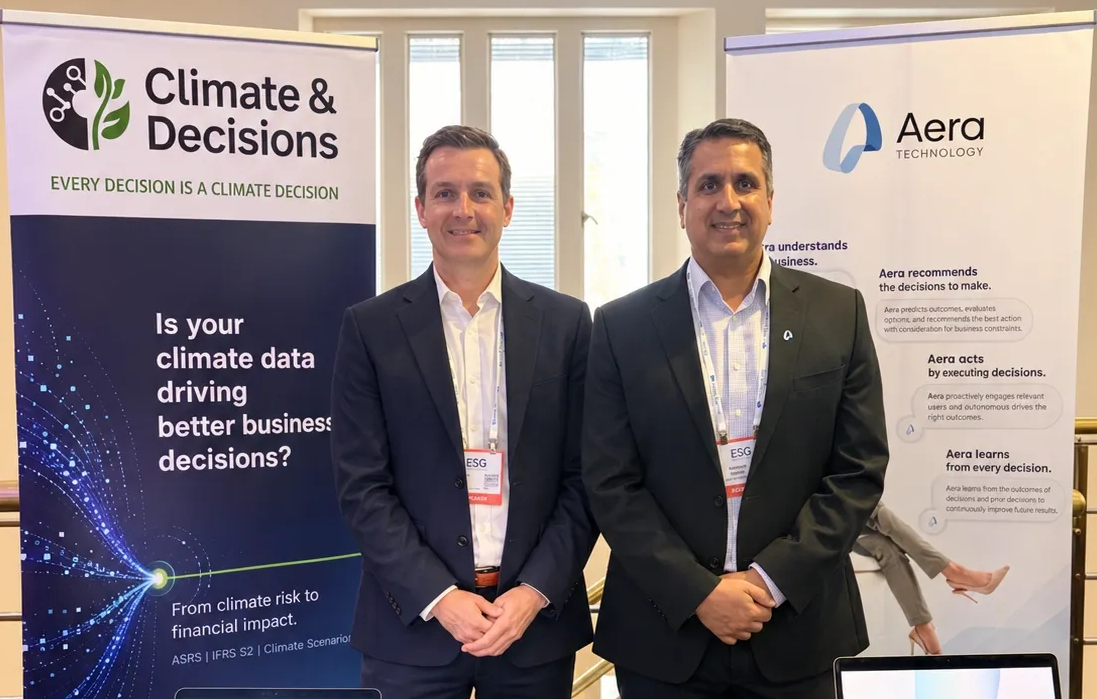
That’s why I was so pleased to see what’s happening in Australia, where Climate & Decisions has partnered with Aera Technology to launch climate decision intelligence, with new Aera Skills that turn climate and sustainability signals into business decisions with financial, operational, and environmental impact.
What I like most about the approach is the ambition to move sustainability data beyond disclosure and into the operational decision itself.
Instead of being measured after the fact and reported periodically, climate and sustainability signals can become part of the decision at the moment an order is placed, a route is chosen, inventory is allocated, or a supplier is selected.
Control is also essential to making this work.
The decision logic is inspectable. Every automated decision leaves a traceable record of the data it used and the reasoning behind it. People set the policies and guardrails and retain authority over the decisions that require human judgment, while routine, high-volume decisions can run autonomously within those boundaries.
That governance is what allows this kind of AI to be trusted inside a real enterprise. It’s also what makes these results achievable today rather than something to imagine for the future.
So when I read the headlines about AI, I keep coming back to the fact that enterprises have a real choice in how they deploy it.
AI can consume resources. But it can also help companies make millions of better decisions about how resources are used: how goods are transported, how inventory is managed, how products are sourced, and how sustainability and climate considerations are incorporated into everyday operations.
And in many of those decisions, sustainability and financial performance do not have to pull in opposite directions. The more sustainable decision can also be the more profitable one.
That opportunity is available right now, in the procurement, logistics, inventory, and supply chain decisions companies are making thousands of times every week.
If you want to see what that looks like in practice, come to AeraHUB 26 in New York City on October 26 and 27, 2026. You’ll hear directly from companies making the most of decision intelligence today, in their own words, and learn about the results they’re seeing in their operations and on their balance sheets.
Register today for AeraHUB 26, the Decision Intelligence Global Summit.
I hope to see you there!