
Decision Engines
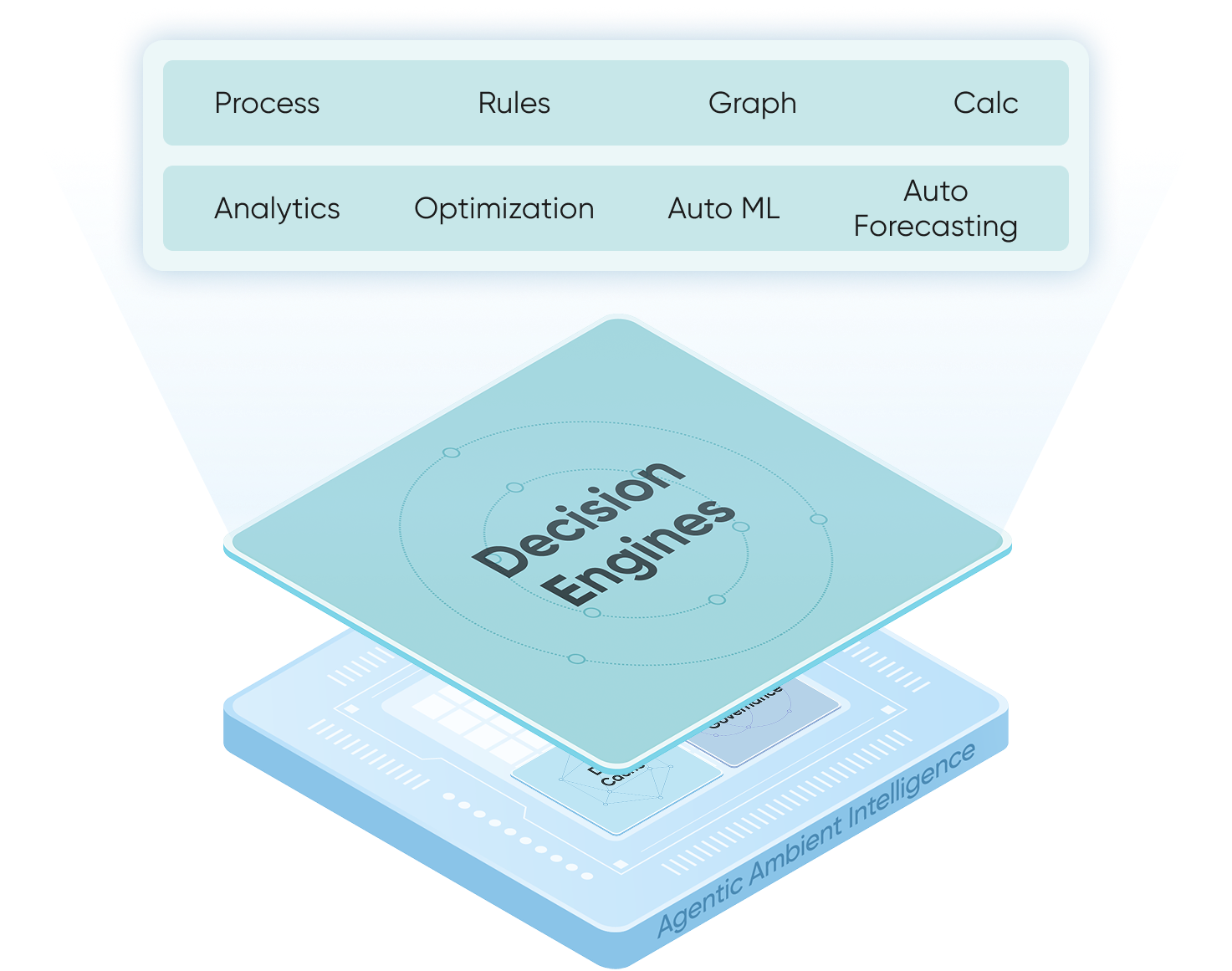
Seven decision engines to support every type of decision, from advised to assisted to fully automated.
-
A complete set of decision engines
Agents, machine learning, analytics, auto-forecast, scenario modeling, optimization, and flows run inside Aera. No separate licenses, setup, or outside tools required.
-
Engines working together
Several engines work on any given decision or situation. Together they analyze data, apply logic, run simulations, and generate recommendations and actions.
-
Use every engine anywhere
Each engine plugs into any decision flow and can be called by agents. Aera’s reasoning invokes the right engines on demand.
Capabilities
Inside Decision Engines
Agents
Build agents without coding
Build agents and agent teams in natural language. Give each agent a defined role, organize them into teams that coordinate decision tasks.
- No coding required. Roles, tasks, and instructions are written as prompts.
- Four agent archetypes. Function agents run deterministic logic. LLM agents handle single-step reasoning. Autonomous agents work through multiple steps within bounds. RAG agents connect with your documents.
- Not everything needs an LLM. Deterministic agents compute. LLM agents reason. Each runs only when the work calls for it. That keeps outputs consistent and token-efficient.
- A shared function library. Turn composed decision processes and external logic into reusable functions that any agent or team can call.
Machine Learning
Automate and deploy ML models quickly
Aera automates feature engineering, model selection, and tuning, so ML models are built and deployed quickly.
- Experimentation is automated. Feature selection, feature engineering, algorithm selection, and parameter tuning run as experiments across 125+ design parameters, 10+ ML algorithms, and 10+ feature transforms.
- One-click deployment. Pick a model and deploy it in one click, with the environment, infrastructure, and web service pre-built.
- Elastic compute. High throughput handles heavy loads, and idle services scale down on their own to cut costs. Validation runs automatically to keep performance up.
Analytics
See the analysis behind a decision
Analysis in Aera is a glass box. Review the figures that informed a decision and drill into the underlying data to understand how those figures were calculated.
- The numbers that matter. Every figure the decision rests on is shown with the recommendation, from supply and demand to projected impact on cost, revenue, or inventory.
- Drill down to the source. Start from any number and follow it down to the underlying data, which stays open for further exploration.
- Works with every engine. Analytics runs alongside ML, simulation, and scenario models inside decision processes.
Auto-Forecast
One model forecasts every product
Get accurate time-series forecasts across thousands of grains, with hierarchical forecasting, overrides, and outside data such as weather built in.
- Auto mode picks the method. Data profiling selects the algorithm and error metric from ML and statistical methods. Accuracy doesn’t depend on hand-built models.
- Relationships across all grains. One deep learning model covers every product and learns how products relate across all grains.
- No-code setup. Specify the data and forecasting task through configuration settings, without writing code.
Scenario Modeling
Build plans, test scenarios, run simulations
Build plans in a multi-dimensional model on live data with an Excel-like formula builder. Compare strategies side by side and trigger actions from the result.
- What-if analysis at enterprise scale. Change multiple variables at once, and simulate complex scenarios with no performance lag.
- Quantify the trade-offs. Compare strategies side by side, quantify trade-offs, and assess outcomes before execution.
- From scenario to action. The outcome of a scenario triggers actions directly, in the same decision process.
Optimization
Industry-leading optimizers, built in
The built-in optimizer finds the best feasible plan when constraints conflict. You can also run CPLEX, NVIDIA cuOpt, or open solvers on your own license.
- Built-in optimizer. The optimizer ships inside Aera, with no separate setup, license, or configuration.
- Bring your own solver. Use custom solvers like CPLEX or NVIDIA cuOpt on your own license. Open solvers like AMPL and Google OR-Tools also work.
- Ready-to-use functions. Pre-built functions cover common optimization use cases, from distribution and truck loading to container utilization.
Flows
Decision logic and execution in one flow
Model a decision as a visual flow. Each node is a step: a data view, a rule, an engine, or an agent. Version control and rollback are built in.
- Build by connecting nodes. Connect data, rules, engines, and agents to define how a decision is made and carried out. Flows are built on Aera’s patented technique for digitizing decision logic.
- AI models and agents run inside the flow. Add AI/ML models, agents, and agent teams as nodes in the flow.
- Full lifecycle management. Manage flows with branching and merging, debugging, version control, process logs, and rollback.
Explore the technology
Other Aera Core Components
Aera's Agentic Ambient Intelligence runs continuously in the background. It knows how your enterprise runs, what you're working on, and which decisions have already been made. The moment a situation demands attention, it reasons across your environment, recommends an action, and executes within the authority and autonomy you set, involving people when judgment or approval is required.
Data Cache pulls the data each decision needs from the systems you already run and from outside sources, and harmonizes it into a live view of your business. Data becomes usable as each source connects, so decisions start on day one.
Dynamic Engagement lets you and the agents you run interact with Aera through an intuitive, natural-language interface. Access it via chat, voice, and desktop, or programmatically through open agent standards. Explore insights, get timely guidance, and take action.
Decisions run within your policy and on your terms. Every automated action traces back to the authority you granted and the autonomy you set, so you have full observability of the decisions and their impact.


