
Agentic Ambient Intelligence
Always-on intelligence that monitors your business, reasons across your environment, and acts within the autonomy you set.
-
From situation to action
Raise a question or exception. Aera assembles the data, weighs options, and recommends an action, then acts on your approval.
-
Governed at every step
You set Aera's authority and autonomy. It acts within those limits, and brings in people when a decision needs judgment or approval.
-
Learns from every decision
Aera captures decisions, their context, and outcomes, then learns from that experience to inform future recommendations.
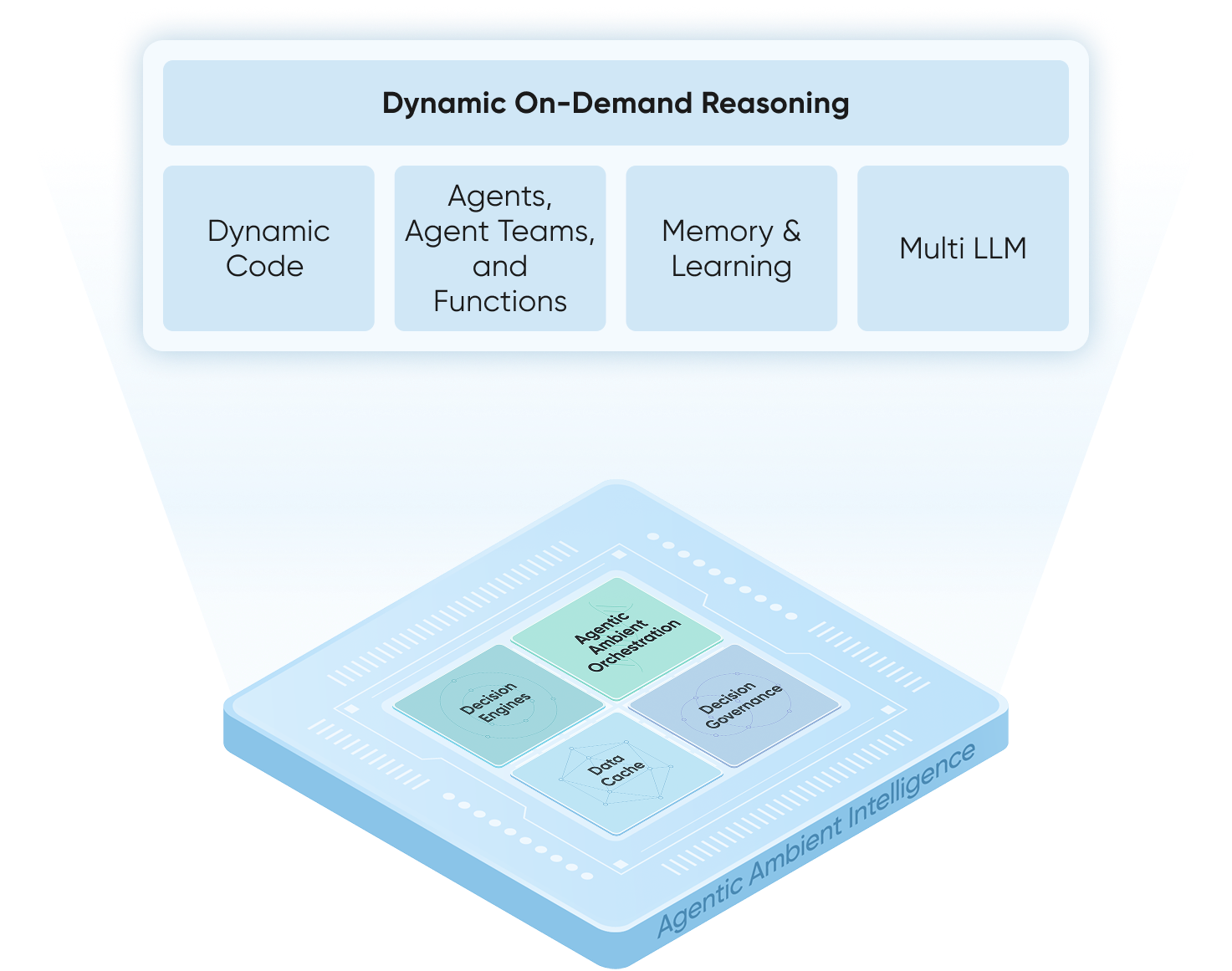
Capabilities
Inside Agentic Ambient Intelligence
Always-on dynamic reasoning
Reasoning across every engine, model, and agent
Aera monitors your environment for situations that need attention. It brings together relevant data, engines, agents, and memory to reason through a decision, involving people when judgment or approval is required.
- Aera knows what to use. It autonomously selects and assembles the data, engines, agents, and memory each situation needs. You don’t have to tell it where to look.
- Token-efficient at scale. Aera uses only the context and resources needed for each situation, helping limit token use as decision volume grows.
- Surface related issues and recommendations. Aera answers the question, then raises related exceptions and open recommendations that may need your attention.
- Human in the loop. When a decision requires human judgment, Aera clarifies or hands off to the right person.
Closed-loop action
From recommendation to measured outcome
Aera acts within the authority and autonomy you set. It writes actions back to operational systems and captures the outcome, so every decision loop closes.
- Builds and executes the decision logic. Aera builds the logic to carry out each recommendation and executes it within your policy guardrails.
- Update systems and inform agents. Aera writes each action into your operational systems and informs the agents involved, so decisions take effect where the work happens.
- The right people stay informed. Depending on the autonomy you set, Aera waits for approval before acting, or acts and notifies the people involved.
- Outcomes close the loop. Aera captures each result and compares it against the expected impact. It learns which recommendations worked and improves the ones that follow.
Memory Atlas
Remembers how your enterprise runs
Operational memory holds the facts, preferences, and constraints about you and your business. Decision memory holds every decision with its context, actions, and impact. Aera weights both by importance and recency.
- Facts, preferences, and constraints. Aera recalls relevant facts, preferences, and constraints to ground decisions in how your business operates.
- Decision memory in detail. Aera captures each decision with its business context, the confidence behind it, the actions taken, the expected impact, and the actual impact.
- Memory stays current. Aera gives more weight to important and recent memories, and less weight to older ones.
Learning
Enterprise knowledge, captured and applied
Aera learns from every decision. It captures each decision, its context, and its outcome, and applies your preferences without being asked, so recommendations sharpen as the decision record grows.
- Learn from decisions and outcomes.Aera uses decision context and outcomes to learn which recommendations worked and inform the recommendations that follow.
- Every response feeds learning. Aera captures users’ responses to recommendations, including why a recommendation was rejected.
- Find the right resources first. Aera learns which data, agents, and tools are relevant for a type of decision, and picks them first next time.
Multi LLM
Choose models for different roles
Configure and manage secure connections to the large language models of your choice, map them to agents by role, and govern usage with granular token budgets.
- Connection setup and testing. Add a connection by specifying model type, authentication, and configuration. Validate each one before deployment.
- Model-to-role mapping. Assign specific models to specific agents and tasks, so the right model supports the right use case.
- Governed usage. Set granular token budgets and track consumption. Usage stays within the limits you define.
- Monitoring and management. View connections, monitor status and usage, and update model parameters or authentication as needs change.
Explore the technology
Other Aera Core Components
Data Cache pulls the data each decision needs from the systems you already run and from outside sources, and harmonizes it into a live view of your business. Data becomes usable as each source connects, so decisions start on day one.
Seven decision engines are built into Aera and support every type of decision, from advised to assisted to fully automated. Several engines work on any given decision, and agents and flows can call any of them.
Dynamic Engagement lets you and the agents you run interact with Aera through an intuitive, natural-language interface. Access it via chat, voice, and desktop, or programmatically through open agent standards. Explore insights, get timely guidance, and take action.
Decisions run within your policy and on your terms. Every automated action traces back to the authority you granted and the autonomy you set, so you have full observability of the decisions and their impact.


