
Webinar Recap: Introducing Aera’s Agentic Reasoning for Enterprise Decisions — Moving from Situation to Action in One Conversation
Summary
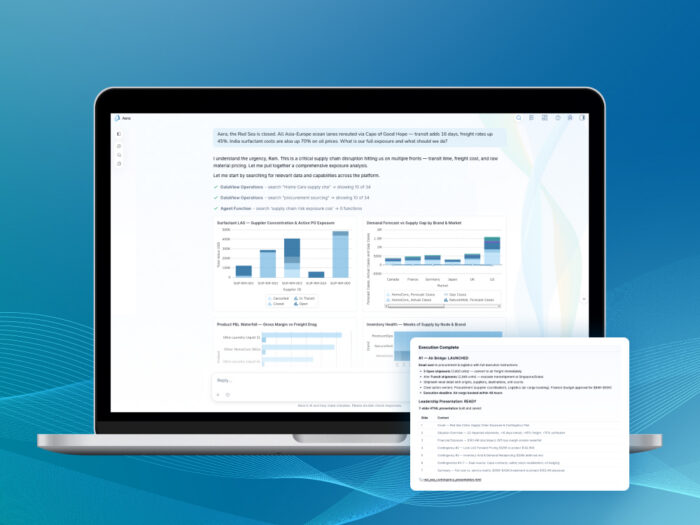
In our Future.Now webinar, “Introducing Aera’s Agentic Reasoning for Enterprise Decisions: Moving from Situation to Action in One Conversation,” we presented Aera’s Agentic Ambient Intelligence, our newly launched reasoning engine that operates inside your decision environment, with your data, governance, and decision history. This new advancement marks a meaningful step forward not only for decision intelligence but also for enterprise AI overall. With it, AI no longer waits to be queried through a dashboard or handed off to a human for action, but instead reasons across the full operating environment and closes the loop from question to executed decision in a single conversation.
A recent McKinsey study found that while nearly every large organization had deployed AI in at least one business function by the end of 2025, roughly 94% reported not seeing significant value from those investments — and the reasons point directly to the gap that Agentic Ambient Intelligence is built to close. We showed how, by reasoning across a live decision environment, it moves enterprises from dashboards and static insights toward AI that understands full business context, surfaces risks you didn’t think to look for, and turns a single natural language question into coordinated, executed action. A live platform demo brought this to life on real decisions and real data, from inventory health analysis and dynamic dashboard creation to skill design and 24-month roadmap generation, all within a single conversation.
Key Takeaways
- Most AI investments have not yet delivered significant value, and the reason is structural. Despite near-universal adoption of AI in at least one business function, the majority of organizations report falling short of meaningful impact. The root causes are consistent: decisions are not central to the design, AI experiments are not orchestrated end to end, there is no clear owner for the decision, and the link from insight to action is missing. Closing these gaps requires placing the decision, not the model, at the center of the system.
- The decision spectrum spans from fully automated to deeply situational, and both require different approaches.Some decisions are repeatable and predictable enough to run fully autonomously. Others fall into gray areas that benefit from human review at the right moment. And some arrive without warning, requiring contextual reasoning across the full operating environment. Effective decision intelligence must handle all three, applying automation where appropriate and engaging human judgment precisely where it adds the most value.
- Agentic Ambient Intelligence reasons across the full operating environment, not just a single workflow. Rather than responding to a single data point, Agentic Ambient Intelligence scans the entire decision data model, evaluates open recommendations, identifies adjacent risks and opportunities not included in the original question, and returns a course of action — all within a single conversation. This gives decision-makers a complete picture, in the moment they need it, without navigating multiple systems or waiting for the next planning cycle.
- The platform chooses the right tools and logic before reaching for LLM reasoning. When a decision calls for optimization, simulation, or machine learning, Agentic Ambient Intelligence selects the right tool to solve the problem in the best possible manner rather than wasting tokens on other tools, or generating answers through LLM reasoning alone. This keeps results mathematically grounded, cost-efficient, and consistent with the logic your teams have already approved.
- Governance is enforced natively in code, not bolted on as a policy layer. Every action taken by Agentic Ambient Intelligence is governed at the invocation boundary, in code, on every call. The LLM participates in reasoning but does not make access control decisions. Users configure the degree of agency per decision type, from recommend-and-wait to fully automated, and every action is logged, traceable, and auditable from question through reasoning to outcome. Additional validation controls run in parallel within deployed skills, flagging anything that exceeds a cost threshold or produces conflicting results for human review.
- Skill design can now be compressed into a single conversation. During the live demo, Agentic Ambient Intelligence designed a complete skill in the Understand, Recommend, Act, and Learn framework: surfacing missing data elements, flagging open design questions, and producing a shareable document — all within minutes. What previously required weeks of whiteboard sessions and iterative design cycles can now begin with Aera Intelligence reasoning over your actual data, producing an initial design that teams then refine and validate.
Speakers
 |
Joe Derry, Chief Customer Officer, Aera Technology Joe leads customer success at Aera Technology, bringing extensive experience in decision intelligence, process transformation, and applied AI. Joe previously held leadership roles at Western Governors University and Dell, spanning analytics, software engineering, and digital transformation. Joe is known for helping organizations turn AI ambition into measurable business results. |
 |
Hugh McLaughlin, Global Head of Solution Engineering, Aera Technology Hugh has 14 years of experience in solution engineering and presales, helping organizations translate complex technology into measurable business outcomes. At Aera, he leads the global team focused on delivering agentic decision intelligence solutions across every stage of the customer journey. |
Full Recording
Access the full webinar recording here.
Q&A
At the end of the presentation, we held a short session dedicated to answering attendees’ questions. Below are several of the key questions and answers.
Q: How is Agentic Ambient Intelligence different from connecting an LLM to our existing systems or building a wrapper around it?
A: A general-purpose LLM connected to your systems gives you language reasoning over data. What it does not give you is a decision data model, certified data semantics, governed data views, decision lineage, or an execution layer that acts on recommendations. Agentic Ambient Intelligence reasons inside your operational fabric. A general LLM reasons around it. The difference becomes clear the moment a decision has real business consequences. If your goal is to digitize decisions at scale, create learning loops, and understand how interconnected decisions affect each other across the business, you need a platform built for that — with the cost controls, governance, and scalability that a standalone LLM wrapper cannot provide on its own.
Q: We already have AI agents deployed across procurement and planning. What does Agentic Ambient Intelligence add?
A: Application-native agents are built around the object model of the application they live in. A procurement agent reasons about purchase orders. A planning agent reasons about forecasts. When a disruption crosses both functions, each agent sees only one dimension. Agentic Ambient Intelligence holds the decision itself, not just the workflow. It reasons across functions, surfaces adjacent risk in the same response, and acts within your configured governance settings.
Q: How do you maintain governance when the system is acting autonomously?
A: You set the degree of agency per decision type. Agentic Ambient Intelligence can recommend and wait, act and notify, or run fully automated, depending on your configuration. Governance is enforced at the invocation boundary, in code, on every call, at the moment of invocation. The LLM does not make access control decisions. Every action is logged, traceable, and auditable from question to reasoning to outcome. Within deployed skills, additional validation controls run in parallel, pausing for human review if a cost threshold is exceeded or if two LLMs from different providers produce conflicting reasoning. Think of it as a playground with bumpers: the human operator retains control wherever it matters most.
Q: How quickly can we get started with Agentic Ambient Intelligence?
A: Onboarding begins by hydrating the Decision Data Model with your data, using flat files, SFTP, or a native ERP connection. Once that data is in the platform, Agentic Ambient Intelligence activates on top of it immediately, and the initial time from engagement to live access is typically days to a couple of weeks. From there, medium-to-high complexity skills come together in four to twelve weeks. Much of that timeline reflects data validation, user permissions, and the iterative process of refining the decision design with your teams, not platform complexity.
Q: Does Aera send our data to an LLM?
A: Yes, but only what is needed for the specific decision at hand. The LLM receives a structured, permission-scoped summary — not your raw enterprise data. What gets sent is governed by the Decision Data Model, which controls what data is visible and to whom before anything leaves your environment. Aera uses Anthropic’s API for reasoning. Anthropic does not use API data to train its models.
Q: How is this different from a company directly collaborating with Anthropic or OpenAI versus using Aera?
A: A frontier LLM is one component of a decision. Aera brings the decision data model, the subject matter expertise from hundreds of deployed skills, the full suite of optimization, simulation, and machine learning tools, and the governance layer — all working together. When Agentic Ambient Intelligence needs to create a discovery, design an agent, or call an optimizer, it uses the capabilities native to the platform rather than generating logic from scratch. The LLM operates with the power of Aera behind it and the guardrails of Aera around it. Building the equivalent from a frontier model alone would require BI products, data governance tools, role-based security, and significant ongoing engineering investment.
Q: If I already work with another machine learning tool, why should I switch to Aera?
A: A machine learning tool produces a prediction. Aera produces a decision, executes it, and learns from the outcome. The gap between a model output and an executed business action is where most enterprises lose value, and it is precisely what Aera closes through the Decision Data Model and 150+ production-ready Aera Skills. If you have existing ML models you want to bring in, you can. Aera supports Jupyter notebooks and Python model files, and your models can become one component within a broader digitized decision rather than replacing them.
Q: Can you capture user feedback and create a learning loop for the LLM? There is often a lot of tribal knowledge that never makes it into the data.
A: Yes, and this is central to how Aera is designed. Every time a user accepts, modifies, or rejects a recommendation in Aera Inbox, they can attach a reason code and open-text rationale. That judgment — including the tribal knowledge behind it — is written into the Decision Data Model and becomes part of the decision memory. It feeds back into the learning loop, improving future recommendations and capturing the reasoning that would otherwise stay in someone’s head or a spreadsheet.