Webinar Recap: EY + Aera — Building the Autonomous Supply Chain with Agentic Decision Intelligence
Summary
As part of EY’s Decision Intelligence Maturity Series, the webinar “Building the Autonomous Supply Chain with Agentic Decision Intelligence” brought together EY and Aera Technology to explore how supply chains are evolving beyond process-driven execution toward faster, more adaptive, and more autonomous decision-making. With business cycles accelerating and disruption becoming the norm, traditional human-led approaches are struggling to keep pace. The conversation focused on how decision intelligence — bringing together AI, data, and automation — enables organizations to make decisions at scale, with some companies now executing as many as 3 million decisions annually.
We also examined how agentic capabilities are reshaping how decisions are made, moving from structured, rule-based processes to more situational and dynamic responses. This shift is driving a new operating model, where machines take on more of the decision-making and execution, while people focus on guiding logic, managing exceptions, and continuously improving outcomes. The result is a more connected, responsive, and resilient supply chain.
Key Takeaways
- Decision intelligence shifts the focus from processes to decisions at scale.
Traditional approaches optimize workflows but fall short as speed and complexity increase. Decision intelligence brings together AI, analytics, and automation to focus directly on decisions, enabling organisations to handle both a higher volume and greater complexity than human teams alone can manage. Many supply chain decisions were once predictable and rule-based, but disruptions such as geopolitical events, supplier failures, and demand volatility introduce constant variability. This is where agentic AI adds real value: handling the exceptions and edge cases that rigid processes cannot anticipate. - The shift to a machine-centric model redefines how work gets done.
Most organizations still operate in a “driver-assist” mode, where technology supports human decision-making. The next stage moves toward machine-led execution, where systems recommend and act, and people focus on defining logic, maintaining guardrails, and ensuring outcomes remain aligned with business goals. The self-driving car served as the central metaphor: just as basic cars automate small tasks like switching on headlights, most companies today are still firmly in the driver’s seat. The destination is something closer to the Zoox vehicle — with no steering wheel, no pedals, no option to revert — for organizations that are ready to commit fully. - Trust in AI-driven decisions depends on four critical capabilities.
For decision-making systems to earn trust, they must demonstrate four capabilities: understand (access to the right data and business context), recommend (explainable suggestions, not black-box outputs), act (the ability to execute), and learn (feedback loops that improve accuracy over time). Explainability was emphasised as critical to change management. Planners have historically tolerated black boxes like MRP and optimizers, but natural language interfaces and narrative reports, such as an agent-generated Monday morning summary, can help bridge that gap and build the confidence needed for broader adoption. - Planning cycles are being redefined by speed, granularity, and automation.
Traditional S&OP and IBP processes are often slow, aggregated, and more akin to reporting cycles than genuine decision processes. Decision intelligence enables more frequent, granular decision-making across every SKU and customer. One example cited: reducing strategic decision cycles from 7 weeks to 7 minutes. This also raises a broader question: if machine-driven execution enables continuous, high-frequency cycles, does the distinction between S&OP and S&OE still need to exist? - Agent architecture matters: functions, teams, and orchestration.
Rather than deploying a generic LLM, Aera’s approach centres on building “agent functions” — a toolkit of analytical capabilities that agents can invoke to complete specific tasks. These functions are then coordinated by an orchestrating agent, much like a home improvement project manager directing specialist tradespeople, each with their own tools and domain expertise, toward a shared outcome. Individual agents also need to sit within a broader team structure to ensure decisions are optimized across the full value chain, not just within a single function. - Roles across the organization are evolving.
Planners are shifting from executing repetitive tasks to becoming “logic owners” — refining rules, managing exceptions, and challenging the model’s assumptions. IT is evolving from data custodian to steward of the “truth layer” that underpins machine execution. More broadly, as agents optimize across the value chain, functional silos between planning, procurement, logistics, and sales will come under increasing pressure. The planner of the future will spend less time fixing today’s problems and more time ensuring the system learns from them. - Change management is the hardest part.
Building confidence in agents is an incremental journey, much like a child learning to ride a bike without hands, starting in a stable environment before progressing. The EY and Aera partnership focuses on helping organizations navigate that human journey, not just implement the technology. For some organizations, the right move may be to remove the option of reverting to old habits entirely, placing people in the back seat, not the front.
Speakers
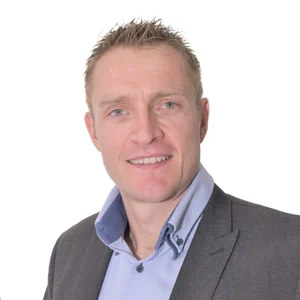 |
Duncan Micklem, Client Partner, Aera Technology Duncan has more than 20 years of experience at the intersection of industrial operations and enterprise software, working with global organizations to turn AI investments into measurable outcomes. His background spans leadership roles at C3 AI, Yokogawa, and KBC, with a focus on closing the gap between strategy and execution and enabling more scalable, data-driven decision-making. |
 |
Matt York, Regional Vice President, Aera Technology Matt brings over 30 years of experience across manufacturing, consulting, and SaaS, helping organizations move from traditional reporting to decision intelligence. His background includes roles at Coca-Cola Enterprises, United Biscuits, Capgemini Invent, PA Consulting, and Crimson & Co. He specializes in driving adoption of technology that delivers measurable results and enables faster, more customer-centric decision-making. |
 |
Einar Scholte, Partner, Supply Chain & Operations, EY Einar brings decades of experience in sourcing, procurement, and value chain optimization. His career includes leadership roles at IBM, PwC, Implement Consulting Group, and BDO Advisory, as well as founding ventures such as November First and Market Facilitator. A published author on sourcing and supply chain strategy, he focuses on helping organizations build competitive advantage through stronger relationships and more efficient, resilient operations. |
 |
Sune Engelsted, Director, Supply Chain & Operations, EY Sune focuses on connecting strategic planning with operational execution across the supply chain. He has led complex digital transformation and optimization programs and previously worked at Grundfos on large-scale SAP APO implementations and continuous improvement initiatives. Known for his analytical rigor and Lean approach, he helps organizations translate strategy into measurable, day-to-day performance. |